

Against the backdrop of an increasingly complex global geopolitical environment, individual countries and regions have frequently generalized national security and industrial policies, intervening in normal cross-border investment activities by setting explicit or implicit discriminatory restrictive measures. This has brought numerous unprecedented uncertainties and institutional barriers to Chinese enterprises engaging in outbound direct investment (ODI). In response to the rigid demand of Chinese enterprises going global, the Provisions of the State Council on Outbound Investment ( hereinafter referred to as "the Provisions") was deliberated and adopted at the 83rd executive meeting of the State Council on April 17, 2026, officially promulgated on May 5, 2026, and shall come into force on July 1, 2026.
As China's first administrative regulation at the State Council level that uniformly regulates all categories of outbound investment, the promulgation of the Provisions completely ends the 40-plus years of fragmented supervision history characterized by "multi-department legislation, conflicting rules, and low legislative hierarchy" in China's outbound investment sector, filling the gap in high-level foreign-related administrative regulations. For enterprises going global, this is not only a management norm clarifying the boundary of rights and responsibilities between the government and enterprises, but also a legal toolbox to defend the legitimate rights and interests of Chinese-funded enterprises in international games.
I. Background for Issuance: Macro Development Trend of Chinese Enterprises' Overseas Investment
With the in-depth advancement of the Belt and Road Initiative (BRI) and the construction of the new "Dual Circulation" development pattern, the quality and scale of China's outbound investment have continued to rise in recent years, demonstrating strong resilience and vitality.
(I) Scale ranks among the top in the world, achieving steady and orderly growth in 2025
According to official statistics from the Ministry of Commerce (MOFCOM) and the State Administration of Foreign Exchange (SAFE), the flow and stock of China's outbound direct investment have long ranked among the top three in the world, and more than 50,000 overseas enterprises have been established in 190 countries and regions. Even amid profound and complex changes in the international economic and trade environment, China's outbound direct investment across all industries has maintained a steady upward trend in the past three years.
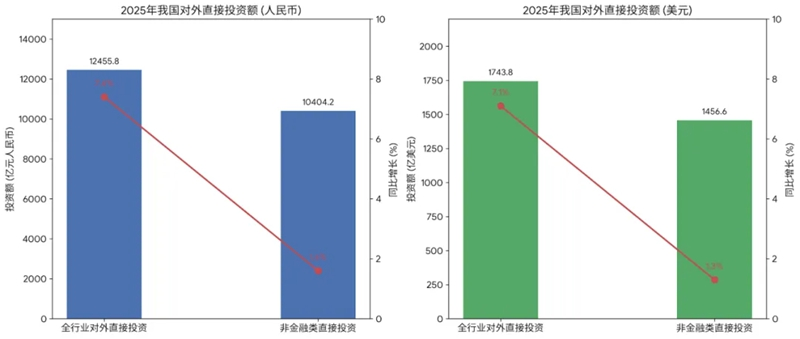
Full-year 2025 data: In 2025, China's outbound direct investment across all industries reached 1,245.58 billion yuan, up 7.4% year on year, equivalent to 174.38 billion US dollars, up 7.1% year on year. Among them, domestic investors carried out non-financial outbound direct investment in 11,048 overseas enterprises in 153 countries and regions around the world, with a cumulative investment of 1,040.42 billion yuan, up 1.6% year on year, equivalent to 145.66 billion US dollars, up 1.3% year on year.[1]
△ Figure 1: Statistical Chart of Outbound Investment Amount in 2025
Latest opening data for 2026: From January to February 2026, China's outbound direct investment across all industries reached 200.15 billion yuan, a sharp year-on-year increase of 25.4%, equivalent to 28.68 billion US dollars, up 29% year on year; from January to April 2026, the cumulative outbound direct investment across all industries reached 429.42 billion yuan, up 3.9% year on year, equivalent to 61.99 billion US dollars, up 7.7% year on year, maintaining an overall steady expansion momentum.[2]
(II) Panoramic Overview of Core Indicators of Outbound Investment in 2025
In 2025, the total outbound direct investment across all industries reached 1,245.58 billion yuan (174.38 billion US dollars), up 7.4% in RMB terms and 7.1% in US dollar terms year on year. The investment scale hit a new high in recent years, and cross-border capital output remained active overall.
In 2025, the total non-financial outbound direct investment reached 1,040.42 billion yuan (145.66 billion US dollars), up 1.6% in RMB terms and 1.3% in US dollar terms year on year. The fundamental market of the real economy going global was solid, covering a total of 11,048 overseas enterprises throughout the year.
In 2025, the total investment in countries co-building the Belt and Road reached 39.67 billion US dollars, up 17.6% year on year, with a growth rate far exceeding the average level of overall outbound investment, and the corresponding proportion of investment in non-financial outbound investment rose to 27%.
In 2025, the total announced amount of Chinese enterprises' overseas mergers and acquisitions (M&As) reached 43.60 billion US dollars, up nearly 40% year on year. After the previous market correction, the M&A market recovered significantly, and the number of large M&A deals with a single transaction of more than 1 billion US dollars increased to 13.[3]
In 2025, the turnover of overseas contracted projects completed reached 152.63 billion US dollars, up 7.7% year on year, hitting a record high in turnover scale, and the influence of China's overseas engineering brands continued to expand.
From the perspective of segmented structure, among the 145.66 billion US dollars of non-financial outbound direct investment in 2025, 39.67 billion US dollars was invested in countries co-building the Belt and Road, and the remaining 105.99 billion US dollars was invested in other countries and regions around the world; in the same year, the total transaction volume of overseas M&As was 43.6 billion US dollars, an increase of nearly 40% year on year. The number of large-scale cross-border M&A transactions increased significantly, and the intensity of cross-border industrial integration continued to increase.
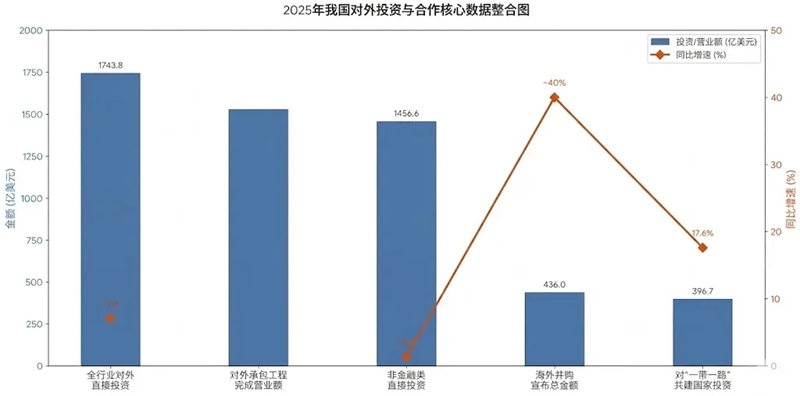
△ Figure 2: Core Data of China's Outbound Investment and Cooperation in 2025
(III) Diversification of Overseas Investment Entities and Structural Upgrading
Combined with macro and segmented investment data in the past two years, the current overseas investment of Chinese enterprises presents three core development trends:
First, the Belt and Road has become the core engine for the high-quality development of Chinese enterprises' outbound investment. In 2025, the growth rate of China's non-financial foreign investment in co-building countries reached 17.6%, more than ten times the overall growth rate of non-financial investment. The proportion of investment continued to rise, and the two-way cooperation between domestic enterprises and the industrial and supply chains of co-building countries continued to deepen.
Second, the activity of private enterprises going global continues to increase, and the overseas M&A market recovers in an all-round way. At present, private enterprises and listed enterprises have become the backbone of China's outbound investment. In 2025, the transaction amount of overseas M&As rebounded sharply by nearly 40%, and M&A transactions in industries such as technology, media and telecommunications (TMT), finance, and energy and power remained highly popular, reflecting the urgent demand of domestic enterprises to integrate global resources, layout overseas brands and sales channels, and deeply integrate into the global industrial division of labor through cross-border M&As.
Third, the contradiction that the domestic regulatory system supply lags behind the practical needs of enterprises going global continues to be prominent. On the one hand, domestic enterprises have strong demand for cross-border investment, while overseas geopolitical and compliance risks continue to rise; on the other hand, in the past, supervision has long relied on segmented supervision by departmental rules of multiple departments including the development and reform department, commerce department and foreign exchange department, with inconsistent regulatory standards, repeated declaration procedures and frequent regulatory blind spots, resulting in high compliance costs for enterprises. As Professor Kong Qingjiang from China University of Political Science and Law said, China's foreign investment legislation lags behind practical needs, and for a long time, outbound investment management and services have been implemented mainly based on departmental rules and normative documents, which are difficult to form comprehensive and effective norms and lack authority and stability. This is also one of the core legislative motivations for the State Council to issue Decree No. 837, the Provisions.[4]
II. Development History: Context of China's Overseas Investment Regulatory Laws and Regulations
To fully understand the institutional innovation value of this new regulation, it is necessary to sort out the more than 40 years of development history of the rule of law in China's overseas investment supervision, which can be divided into four development stages as a whole:
(I) Stage 1: Initial Establishment and Strict Control Period (1979–1999)
In the early stage of reform and opening up, China was in the transition stage from a planned economy to a market economy, with a serious shortage of national foreign exchange reserves. The core principle of outbound investment supervision in this stage was to strictly control capital outflow and implement item-by-item strict examination and approval. In August 1979, the State Council officially issued a document allowing domestic enterprises to set up overseas business entities, marking the official start of China's outbound investment business. At that time, all overseas investment projects needed to be submitted to the State Council for special examination and approval, without simplified approval channels.
In 1985, the former Ministry of Foreign Trade and Economic Cooperation issued the Measures for the Examination and Approval Procedures and Administration of Sino-foreign Joint Ventures Operating Non-trade Businesses Abroad, the first special departmental rule for overseas investment in China, formally establishing the hierarchical examination and approval mechanism for outbound investment. In 1989, the State Administration of Foreign Exchange issued the Measures for the Administration of Foreign Exchange for Overseas Investment, establishing a mandatory foreign exchange source review system and a mandatory repatriation system for overseas investment profits, making pre-approval of foreign exchange an insurmountable pre-threshold for overseas investment. In this stage, investment entities were limited to state-owned enterprises and professional foreign trade enterprises, with a single regulatory body, and a multi-department supervision pattern had not yet taken shape.
(II) Stage 2: Policy Liberalization and Standardization of Approval System (2000–2013)
In 2000, the state officially elevated the "Going Global" strategy to a national-level development strategy. The scale of outbound investment of domestic enterprises expanded rapidly, and the full-project approval system became the legal supervision mode. The dual parallel supervision pattern of the National Development and Reform Commission (NDRC) and the Ministry of Commerce was formally formed, and the prototype of multi-department supervision initially emerged.
At the NDRC level: In 2004, the Interim Measures for the Administration of Approval of Overseas Investment Projects (Decree No. 21) was issued, clarifying that all overseas investment projects, regardless of scale and industry attribute, shall be subject to administrative approval without exemption from filing.
At the MOFCOM level: In 2009, the Measures for the Administration of Overseas Investment (Decree No. 5) was issued, mainly responsible for the establishment of overseas investment entities and the filing and approval management of overseas enterprises.
At the SAFE level: In 2009, the foreign exchange supervision rules for overseas investment were optimized, the pre-approval of foreign exchange was canceled, and the system was fully switched to foreign exchange registration. At the same time, the mandatory repatriation requirement for overseas investment profits was abolished, forming a normalized post-event foreign exchange supervision system.
(III) Stage 3: Market-oriented Reform and Implementation of Filing System (2013–2025)
The Third Plenary Session of the 18th Central Committee of the Communist Party of China clarified the market entity status of enterprises in outbound investment, comprehensively promoted the reform of the investment examination and approval system, and outbound investment supervision officially entered the stage of the reform of "streamlining administration, delegating power, and improving regulation and services", forming a supervision system with filing as the main part and approval as the auxiliary part.
In 2017, the NDRC issued the Measures for the Administration of Enterprises' Overseas Investment (Decree No. 11), drawing up a negative list of sensitive countries and regions and sensitive industries. Projects on the list are subject to approval management, and all other projects are subject to filing management.
In 2014, the MOFCOM revised the Measures for the Administration of Overseas Investment (Decree No. 3), and simultaneously fully implemented the filing system for the establishment of overseas enterprises.
In 2017, the General Office of the State Council forwarded the Guiding Opinions on Further Guiding and Standardizing the Direction of Overseas Investment (Guo Ban Fa [2017] No. 74), dividing outbound investment into encouraged, restricted and prohibited categories at the national level for the first time, focusing on controlling large-scale irrational cross-border M&A projects in real estate, hotels, cinemas, sports clubs and non-core businesses, which became the core policy basis for regulating irrational outbound investment in subsequent years.
Core Supervision Pain Points in This Stage
The reform of the filing system has effectively simplified the process for enterprises to go global. However, constrained by the lack of unified overall planning of high-level administrative regulations, China's outbound investment has always had structural problems of segmented supervision by multiple departments for more than ten years: the NDRC is responsible for macro compliance and national security review of overseas investment projects; the MOFCOM is responsible for the filing and approval of the establishment of overseas enterprises; the SAFE controls the compliance of cross-border capital flows; and the State-owned Assets Supervision and Administration Commission (SASAC) specially supervises the safety of state-owned enterprises' overseas assets.
Separate supervision by multiple departments directly leads to inconsistent regulatory calibers, conflicting approval standards, and the inability to share data and information among departments. When enterprises go through the full set of ODI procedures, they need to submit homogeneous application materials repeatedly to the development and reform and commerce departments, which leads to redundant procedures and longer processing cycles, directly increasing the time cost and compliance cost of enterprises. Meanwhile, the gaps in departmental supervision connection are also prone to regulatory blind spots.
(IV) Stage 4: Upgrade of the Rule of Law (2021–2026)
To solve the pain points of multi-department supervision and cope with the increasingly complex overseas investment security risks, in 2021, the General Office of the State Council and the Ministry of Justice led seven ministries and commissions to launch the legislative work of special administrative regulations on outbound investment, and included the project in the national five-year legislative plan. During the legislative period, the competent authorities carried out multiple rounds of on-site investigations at local levels, coordinated and solved the conflicts of regulatory rules among multiple departments, solicited more than 2,700 opinions from the whole society, and after multiple rounds of revision and improvement, the Provisions of the State Council on Outbound Investment (Decree No. 837 of the State Council) was officially issued in May 2026. The new regulation upgrades the previous fragmented departmental rules and policy documents to national-level administrative regulations, completely reshaping China's overall outbound investment supervision system from the legislative level.
III. Core Institutional Highlights of the Provisions (Decree No. 837 of the State Council)
Professor Han Liyu pointed out that based on China's existing administrative practice of overseas investment, the Provisions adhere to the overall planning of development and security, and presents a legislative idea of upholding integrity and innovation.[5] Combined with the actual needs of enterprises handling ODI business, the core highlights of the new regulation can be summarized into three dimensions: all-round services, whole-process supervision, and whole-process rights and interests protection.
(I) Clearer Division of Powers and Responsibilities of Regulatory Departments
In response to the problems of repeated declarations and inconsistent regulatory standards most frequently reported by enterprises, the general provisions chapter of the Provisions directly clarifies the statutory rights and responsibilities boundaries of the three competent departments, realizing a clear division of regulatory functions: the NDRC takes overall responsibility for macro management, compliance review and national security review of overseas investment projects; the MOFCOM takes overall responsibility for the whole-process management of filing and approval of the establishment of overseas enterprises; the foreign exchange administration department is responsible for the registration of cross-border investment funds and the supervision of the compliance of capital flows.
At the same time, the new regulation clarifies that the original NDRC Decree No. 11 and MOFCOM Decree No. 3 will not be directly abolished, but all contents in the two departmental rules that conflict with the provisions of this administrative regulation shall automatically become invalid as of July 1, 2026, the effective date of the new regulation. In the follow-up, the development and reform and commerce departments will jointly revise supporting implementation rules in accordance with the upper-level administrative regulations, build a multi-department information sharing and one-stop online processing collaborative supervision platform, further simplify ODI application materials and shorten the approval time limit.
(II) Building a Public Service System Platform to Strengthen the Guarantee for Enterprises Going Global
The new regulation completely reverses the traditional supervision thinking of emphasizing approval and neglecting services, and puts investment promotion and public services in the forefront of supervision work. Two major service measures have been implemented:
First, build an integrated country risk public service platform. Governments at and above the provincial level are required to coordinate resources from foreign affairs, legal, fiscal and taxation, finance, customs, council for the promotion of international trade and other parties, regularly release country investment guides and overseas investment risk warning information, fill the information gap of enterprises' overseas investment, and reduce the risk of information asymmetry in cross-border investment.
Second, support the global layout of domestic professional service institutions. For the first time at the administrative regulation level, it is clearly stated that domestic law firms, accounting firms, evaluation institutions, and commercial mediation and arbitration institutions are supported to expand their overseas service networks, and rely on local professional service forces to provide one-stop compliance services for Chinese enterprises going global that meet domestic regulatory requirements and adapt to overseas local rules.
(III) Clarifying Mandatory Requirements for ODI Compliance
The new regulation unifies the national access rules for overseas investment, establishes a whole-process compliance system of pre-access, in-process control and post-event supervision, and clearly delineates the red line for enterprises going global.
1. Unified Access Rules
Chapter III of the new regulation unifies the national access standards for outbound investment, dividing all overseas investment projects into three categories: encouraged, restricted and prohibited. Conventional overseas investment projects in non-sensitive countries and regions and non-sensitive industries are all subject to filing management, fully respecting enterprises' market operation autonomy, with enterprises making independent decisions and bearing risks on their own; administrative approval requirements are only retained for projects in sensitive countries and sensitive industries.
At the same time, the irrational investment restriction requirements delineated in the 2017 Guo Ban Fa No. 74 Document and the previous NDRC sensitive industry catalogues have all been integrated and upgraded into statutory provisions of administrative regulations. The Catalogue of Encouraged/Restricted/Prohibited Overseas Investment (2026 Edition) will be released simultaneously on July 1, 2026 as a unified national legal basis.
2. Full Coverage of In-process and Post-event Supervision to Prevent Filing-only Supervision
The new regulation clarifies that overseas investment is not completed after filing, but is included in the whole life cycle supervision category: in the pre-event stage, domestic investors, including enterprises, partnerships, other organizations and domestic resident individuals, shall complete three statutory procedures in accordance with the law: project approval and filing, overseas enterprise information filing, and cross-border capital foreign exchange registration, to ensure the authenticity and completeness of application materials; in the in-process and post-event stage, a normalized overseas investment information reporting system shall be established, requiring enterprises to regularly submit information related to overseas operation and compliance risk control, improve the internal overseas investment compliance audit mechanism, and strictly prohibit false declaration, split investment, and illegal detour investment in prohibited investment fields.
Compared with the flexible supervision mode of previous departmental rules, this administrative regulation has significantly increased the intensity of punishment, improved the administrative penalty and dishonesty joint punishment mechanism, made up for the shortcoming of insufficient supervision and punishment intensity in the past, and strengthened the rigid constraint of overseas investment supervision.
3. Improving the National Security Review Mechanism for Overseas Investment
Articles 15 and 24 of the new regulation clarify the complete mechanism of national security review for overseas investment. Led by the NDRC, in conjunction with the MOFCOM and multiple ministries and commissions, special security reviews shall be carried out on overseas investment projects, overseas assets and equity transfer behaviors that have national security risks. This system is seamlessly connected with domestic laws and regulations related to export control, data security and cyber security, preventing the abnormal outflow of domestic key core technologies and key links of the industrial chain through cross-border investment.
(IV) Building a Protective Barrier for the Rights and Interests of Chinese Enterprises Going Global
In response to the current situation of targeted containment and discrimination against Chinese-funded cross-border investment in many overseas countries, this new regulation fills the short board of foreign-related investment rule of law and builds a three-tier defensive rights and interests protection system. Professor Ji Wenhua made a special analysis of this system:[6]
1. Establishing a Normalized Country Investment Barrier Investigation Mechanism
Article 23 of the new regulation is linked with the new version of the Foreign Trade Law, clarifying that when domestic investors encounter explicit or implicit investment barriers or unreasonable business restrictions overseas, the national competent authorities may take the initiative to launch a country investment barrier investigation in accordance with their functions and powers. The competent authorities may adjust the investment policies of corresponding countries based on the investigation conclusions, and adopt reciprocal trade and investment countermeasures when necessary to maintain a fair and open cross-border investment order.
2. Setting Up Precise Countermeasures Against Discriminatory Measures at Different Levels
The new regulation sets two complementary countermeasure clauses to achieve full coverage of both national-level discriminatory measures and malicious acts of commercial entities: first, the countermeasure clause against sovereign states and international organizations. If overseas countries and international organizations violate international law rules and implement discriminatory investment restrictions and prohibitions on Chinese investors, China may include institutions and individuals participating in the formulation and implementation of such discriminatory policies in the countermeasure list and implement reciprocal and precise countermeasures; second, the countermeasure clause against malicious acts of overseas commercial entities. If overseas institutions and market entities violate normal commercial transaction rules, maliciously interrupt cooperation, or illegally deprive Chinese enterprises of legitimate investment rights and interests, the domestic competent authorities may adopt restrictive measures against such entities and affiliated enterprises in terms of investment access, trade exchanges, personnel entry and exit, etc., and the countermeasures can penetrate to their domestic and overseas wholly-owned and actually controlled affiliated entities.
3. The Countermeasure Mechanism of the New Regulation Has Pure Defensive Attribute
All the countermeasure clauses added this time are positioned as deterrence and defense rather than active offense. Countermeasures only target overseas illegal bullying, discriminatory supervision, and malicious commercial breach of contract, and do not apply to normal commercial operation disputes and differences in conventional local compliance supervision. As summarized by President Wang Xuekun, this new regulation balances risk prevention and control with reciprocal rights protection, not only building a protective shield for protecting the rights and interests of Chinese enterprises going global, but also equipping them with a legal sword to deal with unreasonable overseas suppression, achieving a two-way balance between development security and rights protection and risk control.[7]
IV. Practical Guide for Enterprises' ODI Compliance After the Implementation of the New Regulation
After the new regulation is officially implemented on July 1, 2026, the effectiveness of the original regulatory documents will change simultaneously. Enterprises need to update their internal compliance processes in a timely manner to avoid compliance risks during the transition period of old and new rules.
(I) Explanation on the Effectiveness Connection of Old and New Regulatory Documents
1. Provisions of the State Council on Outbound Investment (Decree No. 837 of the State Council): Officially implemented on July 1, 2026, it is the highest upper-level law for current overseas investment, and all ODI business handling shall be based on it as the fundamental basis.
2. Catalogue of Encouraged/Restricted/Prohibited Overseas Investment (2026 Edition) and Implementation Measures for National Security Review of Overseas Investment: Implemented simultaneously with the new regulation, they are the direct practical basis for enterprises to judge investment red lines and carry out security review declarations.
3. Measures for the Administration of Enterprises' Overseas Investment (NDRC Decree No. 11) and Measures for the Administration of Overseas Investment (MOFCOM Decree No. 3): They will not be abolished as a whole. Clauses conflicting with the new regulation shall automatically become invalid, and the remaining clauses shall continue to apply during the transition period. The two ministries and commissions will complete the revision of rules in the follow-up to fully adapt to the requirements of the new regulation.
4. Notice of the General Office of the State Council on Forwarding the Guiding Opinions of the National Development and Reform Commission, the Ministry of Commerce, the People's Bank of China and the Ministry of Foreign Affairs on Further Guiding and Standardizing the Direction of Overseas Investment (Guo Ban Fa [2017] No. 74): It will no longer be used as the official direct law enforcement basis, and all investment control requirements in the document have been fully absorbed and upgraded into the main text of this administrative regulation.
5. Guidelines for Compliance Management of Enterprises' Overseas Operations by seven ministries and commissions: The full text remains effective, serving as a standard guiding document for enterprises to build an internal overseas compliance system and risk control system.
6. Special measures for financial outbound investment of the China Banking and Insurance Regulatory Commission and the National Financial Regulatory Administration: They remain effective. Financial institutions' overseas financial investment business shall apply special financial regulations first, and shall not apply this general outbound investment regulation.
(II) Practical Suggestions for Enterprises' ODI Compliance Implementation
First, carry out self-inspection of investment projects in advance and benchmark against the new version of the three-category investment catalogue. Before carrying out various investment businesses such as overseas new establishment, M&A, and overseas capital increase, enterprises must first judge the project compliance against the 2026 edition of the three-category catalogue of outbound investment, directly terminate prohibited projects; adjust the investment structure in advance for restricted sensitive countries and sensitive industry projects; for sensitive investment projects involving core technologies, key minerals and data, reserve sufficient time to carry out national security review in advance.
Second, adapt to the new model of collaborative supervision and avoid the risk of multi-department declaration materials. Continuously pay attention to the implementation dynamics of the joint implementation rules of the development and reform and commerce departments, uniformly fill in the application data relying on the multi-department information sharing platform, ensure that the materials of the development and reform project filing and commerce entity filing have consistent calibers and unified data, and eliminate low-level compliance defects such as material contradictions and information misstatement.
Third, improve the enterprise's long-term overseas compliance governance system. The new regulation has significantly increased the cost of illegal penalties, and enterprises need to completely abandon fluke operations such as investing first and then filing, and false declaration to detour overseas. In accordance with the national compliance guidelines, build a whole-chain internal review mechanism covering cross-border capital flow, annual information reporting, overseas anti-corruption, data compliance, and local employment compliance, and leverage the dividends of national overseas investment public services to ensure that enterprises' cross-border investment is legal and compliant throughout the whole process and achieves steady and long-term development.
Against the macro background of accelerating evolution of the world undergoing major changes unseen in a century, the pace of Chinese enterprises going global has evolved from small-scale pilot exploration to deep-sea voyage. At the turn of old and new supervision, Chinese enterprises going global should be open-minded and cautious in practice. The author would like to conclude with a favorite poem: Do not listen to the sound of rain beating through the forest, why not walk slowly while chanting and whistling.
References
[1] Ministry of Commerce of the People's Republic of China. China's Outbound Direct Investment in 2025. Official Website of the Ministry of Commerce of the People's Republic of China (http://www.mofcom.gov.cn).
[2] Ministry of Commerce, State Administration of Foreign Exchange. China's Outbound Direct Investment Across All Industries Reached 429.42 Billion Yuan from January to April, Up 3.9% Year on Year. https://www.thepaper.cn/newsDetail_forward_33236129.
[3] Ernst & Young. Overview of China's Overseas Investment in 2025. https://www.ey.com/content/dam/ey-unified-site/ey-com/zh-cn/insights/china-overseas-investment-network/documents/ey-overview-of-2025-china-outbound-investment-zh.pdf.
[4] Kong Qingjiang. Coordinating Development and Security to Improve the Outbound Investment Management and Service System. https://www.moj.gov.cn/pub/sfbgw/zcjd/202606/t20260601_535862.html.
[5] Han Liyu. Outbound Investment Legislation Responding to the Requirements of the New Era. https://www.moj.gov.cn/pub/sfbgw/zcjd/202606/t20260601_535863.html.
[6] Ji Wenhua. Safeguarding Outbound Investment with Institutional Innovation to Provide Legal Guarantee for Higher-level Opening-up. https://www.moj.gov.cn/pub/sfbgw/zcjd/202606/t20260601_535860.html.
[7] Wang Xuekun. Safeguarding High-quality Development of Outbound Investment with the Rule of Law. https://www.moj.gov.cn/pub/sfbgw/zcjd/202606/t20260601_535861.html.