

According to preliminary statistics from the General Administration of Customs of China, China's cross-border e-commerce import and export reached 2.63 trillion yuan in 2024, up 10.8% year on year[1]. In the first half of 2024, China's cross-border e-commerce exports to the United States accounted for 34.2%[2]. Along with the rise of China's cross-border e-commerce, the risk of intellectual property infringement litigation has also increased. Taking a recent case of a Chinese e-commerce enterprise being sued for copyright infringement in the United States that consulted us as an example, this article elaborates on the dilemma faced by Chinese e-commerce when being sued for copyright infringement in the United States and the response measures for enterprises.
I. Schedule A Cases: "Invisible Litigation" Targeting Chinese E-commerce
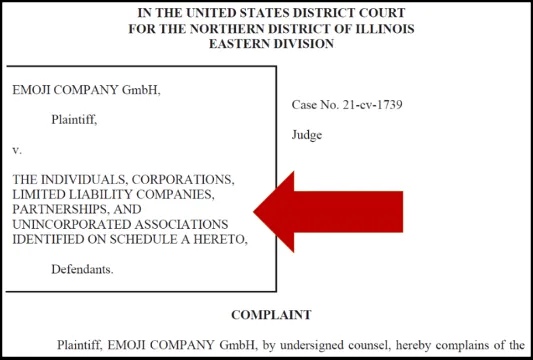
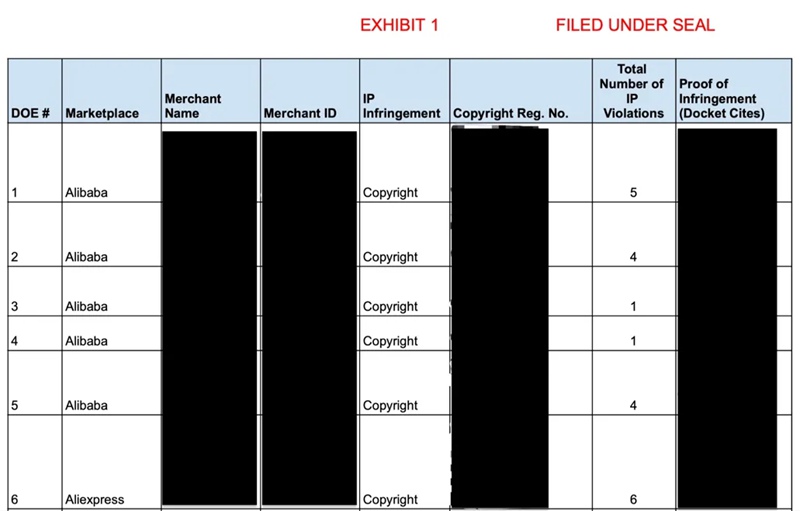
Under the traditional intellectual property infringement litigation mode, the plaintiff files a lawsuit on the grounds that a certain entity infringes its copyright, and the identity of the defendant company is public and specific. In recent years, however, a new litigation mode targeting Chinese e-commerce has emerged in the United States: when the right holder believes that Chinese e-commerce infringes its rights, the right holder will choose to sue a large number of infringers as defendants, and list the information of the infringers in the list of Annex A of the complaint, instead of reflecting it in the complaint, temporarily hiding the identity of the sued party. In this way, except for the right holder and the court, the sued party usually has difficulty knowing that it has been involved in a lawsuit. This litigation mode is called "Schedule A Cases" or "SAD Scheme (Schedule A Defendants Scheme)", which first emerged in Illinois and now shows signs of spreading to other states.
△ Figure 1: Complaint
△ Figure 2: Annex A List of the Consulting Case
On the one hand, suing multiple subjects at the same time can reduce the time cost and cost of litigation to a certain extent. On the other hand, this "invisible litigation mode" provides time convenience for the plaintiff to apply to the court to freeze the defendant's property — the right holder can quickly apply to the court to freeze the defendant's property without the defendant knowing about the lawsuit, avoiding the defendant transferring or concealing property in advance. This is somewhat similar to China's pre-litigation preservation system, the purpose of which is to conceal the fact of the lawsuit and prevent the defendant from transferring property.
Once the accepting court approves the application for property freezing, the plaintiff will immediately notify e-commerce platforms such as Amazon and Alibaba or payment platforms such as Paypal to freeze the defendant's property.
Since Chinese e-commerce enterprises are completely unaware of the lawsuit before their property is frozen, including basic information such as the suing subject, the reason for the lawsuit, and the type of infringement, they basically lose the opportunity to negotiate and settle with the right holder before the freezing, and the time to handle the case is also compressed. At the same time, enterprises are likely to face the situation of capital chain rupture due to property freezing. All these lead to Chinese e-commerce enterprises falling into a relatively passive position in settlement negotiations after their property is frozen.
II. Common Litigation Methods Adopted by Right Holders
01. Temporary Restraining Order
When submitting the complaint, the plaintiff usually applies to the court for a Temporary Restraining Order (TRO)to freeze the property of Chinese e-commerce enterprises.
To freeze the defendant's property quickly and effectively, the plaintiff usually applies for an ex parte TRO, that is, the court will not notify the defendant before freezing the property. According to Article 65.(b)(1) of the U.S. Federal Rules of Civil Procedure, the conditions for a court to issue an ex parte TRO include two items:
(1) The facts in the complaint clearly show that the movant will suffer immediate irreparable injury, loss or damage before the opposing party can object;
(2) The movant's attorney provides written materials explaining the efforts to give notice and the reasons for not giving notice.
For example, in a recent cross-border e-commerce copyright infringement lawsuit consulted by us, the plaintiff's lawyer put forward two reasons for not giving notice to the court: first, the defendants operate anonymously through their online stores, and this anonymous structure makes it very likely that they will transfer data, content, products and property after learning of this lawsuit; second, the plaintiff's law firm has experience in handling similar cases, and relevant experience shows that once the defendants know they are being sued, they always try to transfer property, hide infringing materials and open new accounts.
The accepting court (U.S. District Court for the Eastern District of Texas) held that these two reasons have met the requirements stipulated in Article 65.(b)(1) of the Federal Rules of Civil Procedure, and then agreed to issue the ex parte TRO. It can be seen that the court actually adopts a relatively lenient standard for approving TRO.
However, as a temporary measure, TRO has a time limit. The validity period is usually 14 days, which can be extended by 14 days upon the plaintiff's application. That is to say, the maximum validity period of TRO is 28 days.
Before the TRO expires, the plaintiff usually continues to apply for a Preliminary Injunction (PI) to ensure that the property of Chinese e-commerce enterprises remains frozen.
Unlike TRO, U.S. federal law stipulates that the plaintiff must notify the defendant when applying for PI, so that the defendant has time to prepare a defense. That is to say, even if the Schedule A Cases method is used to hide the plaintiff's information, Chinese e-commerce enterprises should receive relevant materials of the lawsuit at the latest when the plaintiff applies for PI, including the complaint, the motion for TRO, the court's ruling approving TRO, the motion for PI, the court's notice of PI hearing, etc. Therefore, after finding that the account is frozen, Chinese e-commerce enterprises should always pay attention to whether they receive relevant e-mails (usually the e-mail reserved when registering the online store or on the shopping platform), so as to avoid further losing time to handle the case and missing important time nodes such as the hearing date notified by the court.
After the court accepts the application for PI, it usually informs both parties of the date of the hearing, allowing both the plaintiff and the defendant to submit evidence and documents and debate. After hearing the opinions of both parties, the court will decide whether to issue a PI. If Chinese e-commerce enterprises do not attend the hearing, the court may issue a PI in the absence of the defendant and continue to freeze the property of Chinese e-commerce enterprises. PI usually has no clear time limit.
03. Motion for Default Judgment
If Chinese e-commerce enterprises fail to submit a defense to the plaintiff and the court within the time limit specified by the court, the right holder may file a Motion for Default Judgment. If the motion for default judgment is granted, the court usually mainly considers whether the plaintiff's claims are true. Once the motion for default judgment is granted, the defendant shall be liable for every claim asserted by the plaintiff.
After the court makes a default judgment, it will be very difficult for the plaintiff to overturn the judgment, and it must prove:
(1) A reasonable explanation for failing to submit the statement of defense;
(2) A defense on the merits of the case;
(3) The motion to vacate the judgment is made within a reasonable period.
In the Benchmuel v. Gags N Giggles case[3], the defendant failed to submit defense materials beyond the time limit, and hired a lawyer to apply for vacating the default judgment three weeks after the default judgment was issued. The reason given by the defendant to the court was that the defendant "thought" it had reached a settlement with the plaintiff, because at a trade exhibition, the plaintiff's sales representative told the defendant that if the defendant agreed to stop selling and destroy the infringing products and submit written confirmation, the two parties could reach a settlement. However, the court held that this explanation did not constitute a "reasonable explanation", because the defendant had not made efforts to formally reach a settlement. On the contrary, the court held that the defendant's delay reflected its subjective intent and serious disregard for judicial procedures, and rejected its motion to vacate the default judgment. The defendant bore irreversible serious consequences due to ignoring the court deadline and the importance of hiring a lawyer.
A Permanent Injunction is a long-term or permanent order issued by the court, which aims to require one party to stop specific acts or perform specific obligations, and is usually issued at the end of the trial of the case. The court usually considers the following factors when deciding whether to issue a permanent injunction:
(1) Prevailing on the merits of the case;
(2) Economic damages or other compensation are insufficient to compensate the plaintiff's damage;
(3) Balance of interests between both parties;
(4) Whether it violates public interests.
III. Amount of Compensation Faced by Chinese E-commerce Enterprises Involved in Litigation
01. Amount of Judgment Compensation
According to Article 504(a) of the U.S. Copyright Act, the infringer shall compensate:
(1) The actual loss of the right holder and the profits obtained from the infringement, or (2) Statutory damages.
For item (1), when determining the profits obtained by the infringer, the right holder only needs to provide proof of the infringer's total income. If the infringer believes that certain expenses should be deducted or the profits do not belong to the copyright, the infringer shall bear the burden of proof.
For item (2), the standard of statutory damages is 750 US dollars to 30,000 US dollars for each infringing work. If there is willful infringement, the court may increase the statutory damages to a maximum of 150,000 US dollars; if the court finds that the infringer did not know and had no reason to believe that its act constituted copyright infringement, the court may reduce the statutory damages to not less than 200 US dollars as appropriate.
The amount of settlement between the two parties may be affected by multiple factors, such as the number of infringed copyrights, the sales volume of infringing products, the sales amount and profit of infringing products, the amount of frozen property of Chinese e-commerce enterprises, etc. At the same time, whether the lawyer entrusted by the Chinese e-commerce enterprise has similar negotiation experience will also affect the final settlement amount.
IV. Response Measures for Chinese E-commerce Enterprises
01. Find out the account freezing situation as soon as possible, self-check the infringing product information, and track e-mails
After finding that the account is frozen or the platform removes relevant products from the shelves, whether it is a store registered on the platform or its own website, Chinese enterprises should find out the situation of account freezing as soon as possible, and at the same time self-check the types, sales volume, sales amount, profit, listing duration, etc. of products that may be sued for infringement. Under the guidance of lawyers, save and back up all electronic and paper records related to the sued products to provide corresponding evidence for subsequent settlement negotiations or case trials.
As mentioned above, the right holder must notify Chinese e-commerce enterprises at the latest when applying for PI to the court, and the notification method is usually to send e-mails. Chinese enterprises should check relevant e-mails at any time after finding that the account is frozen. But at the same time, it is also necessary to guard against false blackmail emails.
02. While entrusting a lawyer, collect relevant evidence that does not constitute infringement
According to the restrictions on exclusive rights in Articles 107 to 122 of the U.S. Copyright Act, in exceptional cases, the use of others' works may not constitute infringement. The exceptions mainly include: fair use, first sale exception, reproduction by libraries and archives, performance and display in specific circumstances, secondary transmission of cable programs, etc. In addition, the public can freely use works in the public domain (such as objects not protected by copyright law, works whose copyright protection period has expired, etc.).
While self-checking the sales of infringing products, Chinese e-commerce enterprises need to sort out and inform the entrusted lawyer if there are the above exceptions, which will have an impact on determining settlement strategies and litigation strategies.
03. Entrust a lawyer to conduct settlement negotiations or formulate litigation strategies
Since U.S. litigation takes a long time and costs a lot, and long-term freezing of Chinese e-commerce funds may have other adverse consequences beyond the case itself, we suggest that Chinese e-commerce enterprises entrust a lawyer to communicate with the other party as soon as possible after knowing the lawsuit and confirming the existence of infringement, so as to reach a settlement.
Our Chinese and American lawyers will jointly provide legal services for Chinese e-commerce enterprises, promote the settlement procedure as soon as possible, and help Chinese e-commerce enterprises lift the property freeze as soon as possible.
If Chinese e-commerce enterprises meet the circumstances of non-infringement and have relevant evidence, they can also consider entrusting a lawyer to respond to the lawsuit, and local American lawyers will comprehensively evaluate the case and formulate litigation strategies.
04. Arrange time reasonably to avoid missing important time nodes
As the real case mentioned above, if you ignore the case or delay handling it when you know you are being sued, it may lead to more serious adverse consequences. Chinese e-commerce enterprises should pay attention to reasonably arranging the time for entrusting lawyers and collecting materials, so as to avoid bearing irreversible adverse consequences due to missing important time nodes such as submitting defense, hearing, and submitting evidence required by court documents.
[1] https://www.gov.cn/zhengce/jiedu/tujie/202501/content_6998286.htm
[2] https://www.gov.cn/lianbo/bumen/202410/content_6980300.htm
[3] https://www.bennettjones.com/Blogs-Section/No-Second-Chance-Default-Judgment-Stands-Against-Infringers